Surprising statistic: a large share of DeFi losses stem not from sophisticated exploits but from users approving or signing transactions they didn’t fully understand. That is the design problem Rabby attempts to solve: make signing explicit, granular, and avoid “blind signing.” For U.S.-based DeFi power users who hop between Ethereum, rollups, and dozens of EVM chains, the wallet you choose should reduce cognitive friction while preserving security controls. Rabby’s selling point is mechanistic: it simulates transactions, scans risks before signing, and automates network switching — features that change how permission and signing risk are managed in real time.
This article compares Rabby to typical alternatives, explains how its core mechanisms work, and gives practical trade-offs for advanced users. You will leave with a sharper decision framework: when Rabby’s simulation-first model is worth adopting, what it cannot do for you (and why that matters), and how to combine Rabby with hardware and institutional controls to reduce attack surface without losing DeFi composability.
How Rabby works at the mechanism level
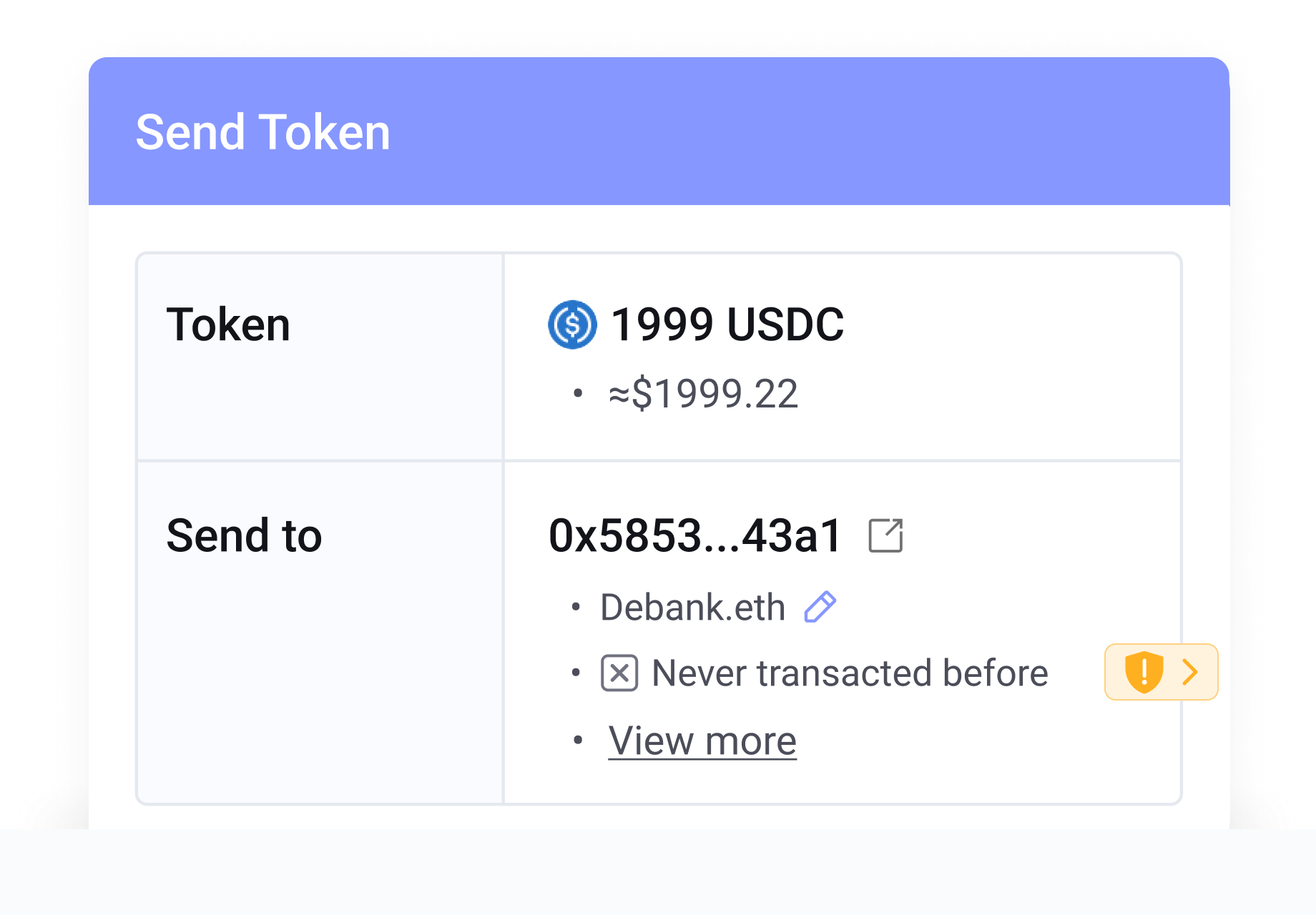
Rabby is a non-custodial, open-source wallet built by DeBank and available as a Chromium browser extension (Chrome, Brave, Edge), mobile app (iOS/Android), and desktop client (Windows/macOS). Its core innovations are procedural: before any on-chain signature, Rabby runs a local simulation of the transaction and presents estimated token balance deltas and fee costs. That single mechanism converts an otherwise opaque approval into quantified effects: you see, for example, that approving a contract will allow X tokens to be moved, or that a swap would change your balances by specific amounts after fees.
Two other mechanisms matter for power users. First, Rabby runs a pre-transaction risk scan that matches transaction data against a database of risky contracts, suspicious approvals, and prior exploits. Second, it automates network switching: when you open a dApp on Arbitrum, Rabby will switch to that network for you. The wallet also aggregates portfolio data across 90+ EVM chains, helps top up gas cross-chain, and integrates with hardware and enterprise signing solutions for higher-assurance workflows.
Side-by-side: Rabby versus common alternatives
When comparing Rabby with incumbents like MetaMask, Trust Wallet, and Coinbase Wallet, focus on three decision axes: transaction clarity (does the wallet prevent blind signing?), composability (how seamlessly does it work across dApps and chains?), and institutional integration (hardware, multi-sig, and custody compatibility).
On transaction clarity, Rabby’s simulation and explicit balance deltas are a substantive improvement over standard UIs that show only calldata or raw approvals. On composability, Rabby supports 90+ EVM chains and automatic network switching, which reduces manual errors but can also mask chain-specific nuances unless you stay attentive. For institutional and high-value users, Rabby integrates with Gnosis Safe, Fireblocks, Amber, and other enterprise tools — a sign it is engineered to slot into multi-sig and custodial workflows.
But there are trade-offs. Rabby lacks a built-in fiat on-ramp and native in-wallet staking, features that some competitors include to lower onboarding friction. If you need to buy crypto with fiat inside the wallet or stake tokens through the wallet interface itself, Rabby delegates those actions to external services or dApps. Also remember the 2022 Rabby Swap incident: a smart contract exploit led to roughly $190k in losses. The team froze the contract and compensated users, and the episode prompted more audits; still, it is a reminder that even wallets with strong local controls can be affected by associated smart contracts.
Security model: what Rabby secures and what it doesn’t
Mechanistically, Rabby reduces four common attack vectors: blind signing, unnoticed approvals, accidental chain mismatches, and insufficient gas on foreign chains. The simulation prevents blind signing by showing concrete balance changes; the approval revocation tool lets you cancel token allowances after the fact; and cross-chain gas top-up addresses a practical operational failure mode where a user is blocked by zero gas on a chain.
What Rabby does not replace is fundamental custodial risk management or off‑chain threats. It is non-custodial by design, meaning private keys stay with the user or hardware device. If you lose a seed phrase or expose a private key, no simulation can save the assets. Likewise, Rabby does not offer native fiat on‑ramp services or built-in staking; users must use external platforms for those activities. The open-source MIT license improves auditability, but open code alone is not a security guarantee — vulnerability discovery is probabilistic and contingent on active audits and threat modeling.
Best-fit scenarios: when to download Rabby
If you are a DeFi power user who trades across rollups, participates in complex approval-based interactions (e.g., DEX routing, permissioned contracts), or manages multiple EVM wallets, Rabby is designed for you. Its transaction simulation and pre‑sign risk scanning remove a predictable class of human error that causes many routine losses. Institutional users who need multi-sig workflows will appreciate the integrations; power users who prefer hardware key security can connect Ledger, Trezor, Keystone, and other devices.
Conversely, if your priority is fiat onboarding, one-click staking, or a single mobile-first consumer experience tied to a custodial exchange, Rabby’s current limitations (no built-in fiat on‑ramp, no native staking UI) make other wallets more convenient. That’s a deliberate trade-off: Rabby emphasizes transparency and composability rather than bundling financial services inside the wallet.
Practical download and setup checklist (U.S. perspective)
If you decide to try Rabby, follow these steps to align convenience with security: 1) Download the official extension or client from trusted sources and verify checksums where available. 2) Start with a hardware wallet connection for large balances; use Rabby’s integration list to confirm compatibility. 3) Import or create wallets but treat seed phrases as high‑security credentials — store them offline. 4) Before interacting with high-value dApps, enable simulation view and confirm the simulated balance deltas. 5) Use the approval revocation tool periodically to remove stale allowances; this reduces the blast radius of a compromised dApp. Finally, for U.S. users, factor tax and regulatory recordkeeping into your workflow: Rabby’s portfolio aggregation helps produce transaction histories that tax software or accountants will expect.
For a reliable download link and basic documentation that aggregates Rabby resources, see this guide to rabby.
Where the approach breaks and what to watch next
Rabby’s simulation-first architecture addresses a human‑fail mode, but several boundaries remain. First, simulations are only as accurate as node state and gas estimations; in periods of rapid mempool churn or when interacting with complex contracts (e.g., meta-transactions, gasless abstractions), a simulation might diverge from final execution. Second, the wallet’s reliance on third-party contract code (like Rabby Swap historically) means that even if the local signing process is secure, the ecosystem’s smart contracts remain a major risk vector.
Watch these signals for future impact: broader adoption of transaction simulation in competing wallets (which would reduce Rabby’s differentiation), expansion of on‑chain staking protocols that can be safely integrated, and improvements in composable wallet standards that make approval scoping more granular. If regulators in the U.S. push for clearer custody definitions or KYC thresholds tied to wallets, integration patterns and user workflows could further evolve. These are conditional scenarios: their realization depends on developer incentives, audit practices, and regulatory choices.
FAQ
Is Rabby safe to download and use for large balances?
Rabby provides strong tooling — transaction simulation, risk scanning, approval revocation, and hardware wallet integration — that collectively reduce many common operational risks. For very large balances, pair Rabby with a hardware wallet and multi-signature custody (Gnosis Safe, Fireblocks, etc.). Remember that “safe” is layered: Rabby handles UI-level signing risks well, but custody practices, seed phrase protection, and contract-level risk still matter.
Can I buy crypto with fiat inside Rabby?
No. Rabby currently does not include a built-in fiat on‑ramp. Users who need to purchase crypto with USD should use a regulated exchange or third-party service, then transfer assets into Rabby. This separation reduces attack vectors inside the wallet but adds a step to onboarding.
Does Rabby work on all browsers and operating systems I use?
Rabby supports Chromium-based browsers (Chrome, Brave, Edge), iOS and Android mobile apps, and desktop clients for Windows and macOS. For browser use, prefer a Chromium variant to ensure the extension behaves as intended.
How reliable are Rabby’s transaction simulations?
Simulations materially reduce blind-signing errors by showing expected balance deltas and fees, but they are not perfect predictors. Accuracy depends on node state, mempool conditions, and contract complexity. Treat simulation as a crucial risk-reduction step, not an absolute guarantee.
Decision takeaway: if your priority is reducing signing errors, managing multi‑chain activity, and integrating hardware or multi‑sig workflows, Rabby’s simulation-first design materially changes the risk calculus. If you need fiat rails or in-wallet staking, be prepared to use external services. For power users, the best practice is hybrid: use Rabby for day-to-day dApp activity and approvals, combine it with hardware and multi-sig for reserve holdings, and monitor contract-level risks before granting long-lived approvals.
Leave a Reply