Imagine you’re about to interact with a new liquidity pool on Arbitrum from your laptop in New York. You click “Confirm” in your wallet and—unlike other wallets that ask for a simple signature—this one shows a clear, line-by-line simulation of what will change in your token balances and the gas cost you’ll pay. That moment of clarity is the practical difference Rabby Wallet promises: fewer blind signatures, better situational awareness, and fewer surprise losses when interacting with complex DeFi flows.
This article unpacks how Rabby’s mechanism-first features actually alter the risk profile for a sophisticated U.S.-based DeFi user, which common myths about multi-chain wallets deserve correction, and what trade-offs remain. You’ll get a working mental model for when Rabby materially helps you, when it doesn’t, and how to make a pragmatic install-and-use decision.
Core mechanisms: transaction simulation, risk scanning, and multi-chain ergonomics
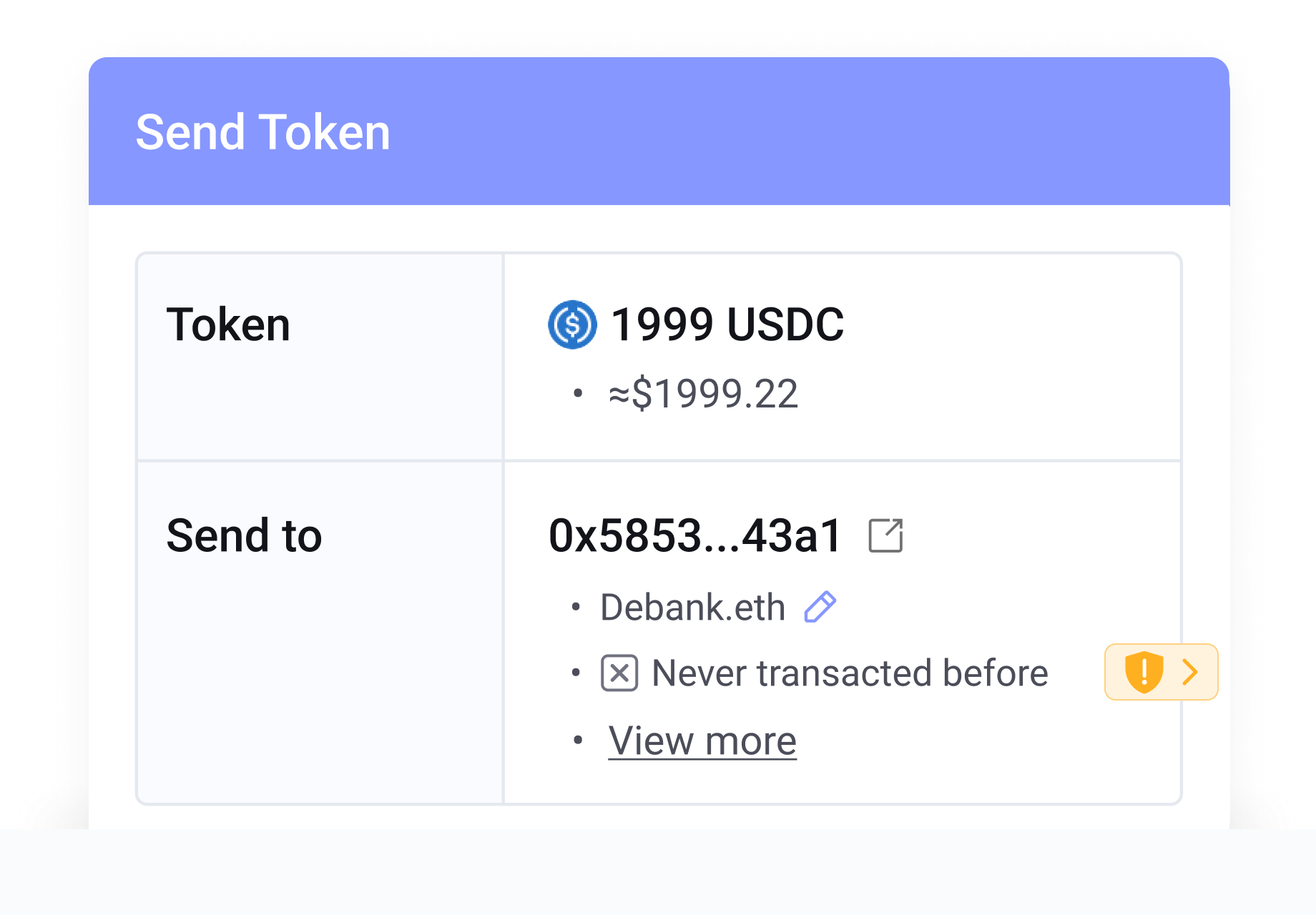
Rabby combines three mechanisms that matter for active DeFi users. First, pre-transaction simulation: before you sign, Rabby computes an estimated post-transaction token balance delta and fee cost. Mechanically, that means it replays the transaction call(s) against a node or local simulator to show outcomes you would otherwise infer only from raw calldata. The benefit is straightforward: you replace guesswork with explicit estimates, reducing “blind signing”—a frequent cause of accidental token drains.
Second, Rabby runs a security engine that flags known risky patterns: previously exploited contracts, suspicious approval requests, or recipient addresses that don’t appear to exist. This is not a formal guarantee; it is a screening layer that raises or lowers your attention threshold. Third, the wallet’s automatic network switching and broad EVM coverage (90+ chains) lower friction when you move between Ethereum, Arbitrum, Optimism, Polygon, Avalanche, BNB Chain, and others—important for power users who routinely cross-rollup boundaries.
Myth: “All wallets are the same—use MetaMask and you’re fine”
Reality: wallets differ in instrument-level tooling that matters to active DeFi traders. MetaMask, Trust Wallet, and Coinbase Wallet are widely used, but they typically do not display the same granular pre-signature simulation that Rabby emphasizes. For a user executing complex swaps, batch contract interactions, or multi-step bridging, seeing the exact balance deltas and approving revocations natively changes decision quality.
That said, “different” does not mean “better in every way.” Rabby’s edge is situational: if most of your activity is simple transfers or custodial exchange trades, the simulation and approval management may be low-value. Conversely, if you manage LP positions, use new dApps, or maintain on-chain portfolios across chains, Rabby’s toolset meaningfully reduces accidental exposures.
Security posture: open-source, hardware wallets, and an honest incident history
Rabby is open-source under the MIT license and integrates with leading hardware wallets (Ledger, Trezor, Keystone, CoolWallet, GridPlus, BitBox02). Open source and hardware compatibility are strong signals: they permit independent audits and reduce single-vendor trust. In practice that means a sophisticated institution or individual can attach an air-gapped hardware signer and still benefit from Rabby’s pre-signature simulations and approval-revocation UI.
But open-source status is not a panacea. Rabby’s history includes a 2022 incident where a Rabby Swap-related smart contract was exploited for about $190,000. The team froze the contract, compensated users, and increased audits—an important sequence that shows responsible incident response. For readers: treat past remediation as a positive signal of maturity, not as proof that future bugs are impossible. Security in DeFi is probabilistic and depends on protocol complexity, audit coverage, and operational hygiene.
Practical trade-offs and limitations you must weigh
1) No in-wallet fiat on-ramp. If you prefer buying crypto with a bank card inside the wallet, Rabby currently lacks that feature. That creates a two-step onboarding for many U.S. users: on-ramp via an exchange, then transfer to Rabby—an extra custody handoff and timing risk.
2) No native staking flows. If you want to stake tokens inside the wallet UI, you’ll still rely on external dApps or native chain tooling. That’s not a security failure, but it reduces convenience for certain yield strategies.
3) Simulation is strong but not omniscient. Simulators use current node state, gas models, and contract code to estimate outcomes. They can fail in edge conditions—front-running, MEV sandwich attacks, or when transactions interact with off-chain or oracle-dependent logic—so the simulation reduces but does not eliminate risk.
4) Integration surface: Rabby connects with institutional solutions (Gnosis Safe, Fireblocks, Amber, Cobo Wallet). While this increases enterprise usability, each integration increases the attack surface and operational complexity. Institutions should still layer internal controls and key-management policies on top of Rabby.
Installation and ergonomics: getting Rabby on your device
Rabby ships as a Chromium-based browser extension (Chrome, Brave, Edge), mobile apps for iOS and Android, and desktop clients for Windows and macOS. For a cautious power user in the U.S., a sensible install path is: add the browser extension, import or create a non-custodial wallet, pair a hardware device for high-value accounts, and enable the approval revocation tool to audit existing token allowances. If you want a quick walkthrough the project provides documentation and an install page that explains platform-specific steps: https://sites.google.com/cryptowalletextensionus.com/rabby-wallet/
One practical heuristic: keep three tiers of addresses. Tier 1: hardware-backed “vault” for high-value holdings and multisig. Tier 2: hot wallet with Rabby’s simulations enabled for active trading and interactions. Tier 3: disposable addresses for airdrop claims and untrusted dApps. Rabby’s Flip toggle (swap default wallet between Rabby and MetaMask) and wallet-import features make this workflow operationally feasible.
Decision framework: when Rabby should be on your short list
Consider Rabby if any of these apply: you regularly sign complex DeFi transactions, you manage money across multiple EVM chains, you want native approval revocations, or you need robust hardware-wallet support combined with simulation. If your needs are simpler—store-and-hold for the long term with occasional centralized exchange trades—Rabby’s advanced tooling is helpful but not essential.
Also weigh institutional needs: Rabby’s integrations with Gnosis Safe and enterprise custody solutions make it attractive for teams, but formal security reviews and internal policies should still govern key management and multi-sig thresholds.
What to watch next (conditional signals, not promises)
Watch for three conditional signals that would increase Rabby’s long-term value proposition. First, broader native fiat rails inside the wallet—if Rabby adds a regulated U.S.-compliant on-ramp, onboarding friction drops and the wallet becomes more competitive for mainstream users. Second, deeper on-chain staking or liquid staking integrations—this lowers the switching cost for yield-seeking users. Third, repeated public security audits and bug-bounty results that show declining severity of reported issues; that will strengthen confidence among institutional integrators. None of these are guaranteed; they are plausible extensions that would change the calculus for different user types.
FAQ
Does Rabby eliminate the risk of signing a malicious transaction?
No. Rabby reduces the probability of blind-signing through pre-transaction simulation and risk scanning, but simulations can miss dynamic or off-chain behaviors (oracles, oracle-manipulation vectors, MEV, time-dependent state). Treat Rabby as a stronger filter, not an absolute safeguard.
Can I use Rabby with my Ledger or Trezor?
Yes. Rabby supports a wide range of hardware wallets (Ledger, Trezor, Keystone, CoolWallet, GridPlus, BitBox02) so you can pair a cold signer with Rabby’s UI and simulation features for higher assurance.
Is Rabby suitable for institutional use?
Rabby integrates with institutional and multi-sig services such as Gnosis Safe, Fireblocks, Amber, and Cobo Wallet, which makes it usable in institutional workflows. However, institutions should combine Rabby with formal key-management policies, audits, and internal controls.
How does Rabby compare to MetaMask?
Both are non-custodial EVM wallets, but Rabby emphasizes built-in transaction simulation, pre-transaction risk scanning, approval revocation, and automatic network switching. MetaMask remains ubiquitous and broadly integrated; choose based on whether Rabby’s simulation and approval tools measurably improve your operational safety.
Leave a Reply